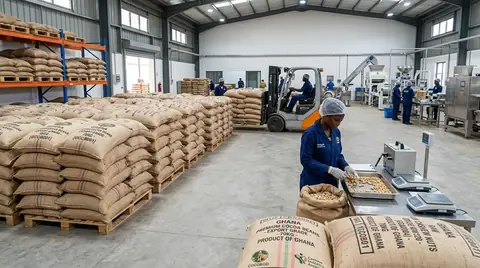
Demonstration listingExample · Premium level
Abidjan, Ivory Coast
Lagune Agro-Industries
Agriculture & Agro-processing
Palm oil, natural rubber and sugar from Ivorian plantations
Catalogue preview
Crude Palm Oil (CPO)Natural Rubber TSR 10 / TSR 20
Raw agricultural commodities, organic oils, cocoa, coffee, cashew nuts, fresh fruits, vegetables and agro-industrial equipment.
Pilot phase: the listings shown are demonstrations, labelled as such.
Agriculture & Agro-processing
Palm oil, natural rubber and sugar from Ivorian plantations

Agriculture & Agro-processing
Leading Moroccan exporter of certified organic argan oil and extra virgin olive oil
Agriculture & Agro-processing
Ivorian processor of certified Grade 1 cocoa beans and pure cocoa butter

Agriculture & Agro-processing
Bulk cocoa beans, Robusta coffee and natural rubber from Abidjan
These companies have another main sector, so they are not counted here.
Manufacturing & Industrial
Phosphate-based fertilizers and soil nutrition blends for African agriculture
Food & Beverage
Refined sugar and edible oils for Central African food manufacturers
Food & Beverage
Cocoa beverages, seasonings and packaged foods for West African retail
Agriculture & Agro-processing sector: 4 listings have it as main sector in the SocoAfrica directory. Countries where the sector is covered: Morocco, Senegal, Ivory Coast, Ghana, Nigeria, Cameroon and Kenya.
Practical guides related to the sector, each with its official sources:
Buying cocoa in Côte d'Ivoire: exporter licensing, quality and ports: What should a buyer check before dealing with an Ivorian cocoa exporter? Its licence from the Conseil du Café-Cacao, the bean quality requirements and the role of the port of San-Pédro.
Exporting sesame and cashew from Nigeria: NEPC, NAQS and Form NXP: A non-oil agricultural export from Nigeria takes three steps. The exporter registers with the NEPC, then NAQS inspects the goods and issues the phytosanitary certificate. Last comes the electronic NXP declaration.
Exporting cocoa and coffee from Cameroon: the ONCC and approved ports: In Cameroon, the National Cocoa and Coffee Board (ONCC) oversees the sector and tests every lot before export. Exports leave through the approved ports of Douala, Limbe and Kribi.
A buyer can post a free request for quotation for this sector: our team reviews it, then forwards it to listed suppliers. A company in the sector can list for free and apply for the Verified badge, awarded after a check of its documents.
What should a buyer check before dealing with an Ivorian cocoa exporter? Its licence from the Conseil du Café-Cacao, the bean quality requirements and the role of the port of San-Pédro.
A non-oil agricultural export from Nigeria takes three steps. The exporter registers with the NEPC, then NAQS inspects the goods and issues the phytosanitary certificate. Last comes the electronic NXP declaration.
In Cameroon, the National Cocoa and Coffee Board (ONCC) oversees the sector and tests every lot before export. Exports leave through the approved ports of Douala, Limbe and Kribi.
In Kenya, tea exporters must register with the Tea Board as buyers or exporters; phytosanitary certification is handled by KEPHIS.
In South Africa, every citrus export lot is certified by the PPECB, which acts on behalf of the Department of Agriculture. Each lot also needs an electronic phytosanitary certificate from the national plant protection organisation.
The cashew nut grows beneath a fleshy false fruit, on a tree native to the Americas that is now grown across the tropics. This guide explains the tree, harvesting and drying, then Côte d'Ivoire's position as the world's leading producer, its local processing and its export rules.
The cocoa price in Côte d'Ivoire is a guaranteed producer price, set each season by the State and the Conseil du Café-Cacao. This guide explains the mechanism, traces farm-gate prices for recent seasons with their sources and places Ivorian production in the world.
Post a request for quotation: our team forwards it to listed suppliers.