Cashew nuts: the tree, the harvest and exports from Côte d'Ivoire
SocoAfrica editorial team · Updated on
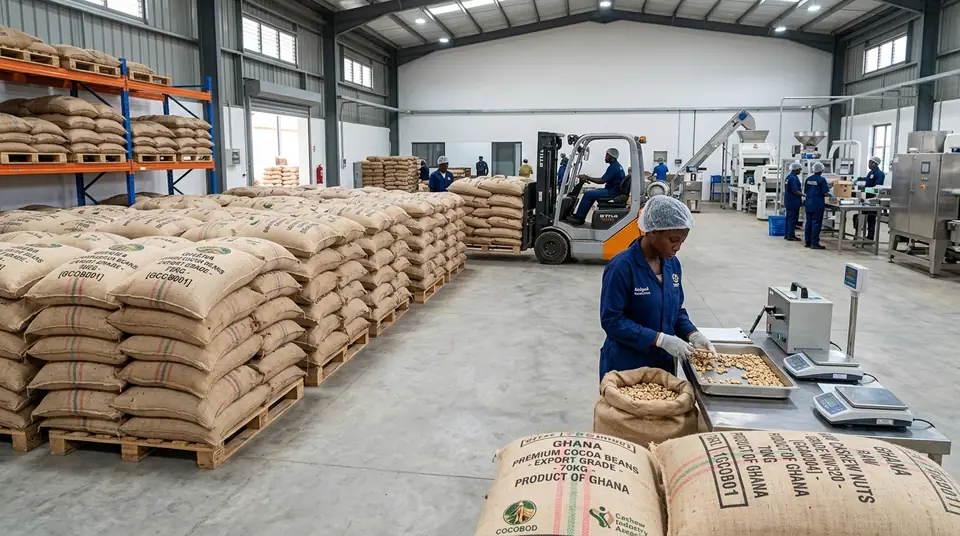
The cashew nut grows beneath a fleshy false fruit, on a tree native to the Americas that is now grown across the tropics. This guide explains the tree, harvesting and drying, then Côte d'Ivoire's position as the world's leading producer, its local processing and its export rules.
Key points
- The cashew tree (Anacardium occidentale) starts bearing in the third year after planting and reaches full yield after 8 to 10 years, according to FAO.
- Côte d'Ivoire has been the world's leading cashew producer since 2015, with 1.225 million tonnes produced in 2023 according to the Cotton and Cashew Council (MEPD, 2024).
- The share of production processed locally rose from 6.22% in 2016 to 21% in 2023 (MEPD, 2025).
- For the 2025 season, the farm-gate price was set at CFA 425 per kilogram, and a supply period reserved for local processors preceded the opening to exporters (MEPD, 2025).
The cashew nut tree
The cashew nut tree is Anacardium occidentale, of the Anacardiaceae family. According to FAO, it is native to Central and South America and is now widely grown in the tropics, especially in parts of Africa and Asia. In French they are also called “anacardes”.
The tree starts bearing in the third year after planting, reaches full yield after 8 to 10 years and keeps producing for about 30 years (FAO). It is therefore a long-term crop, which explains the relative stability of supply from one year to the next.
In French, 'anacarde' refers to both the tree and its nut. In statistics and contracts, 'raw cashew nut' refers to the nut in its shell and 'kernel' to the shelled product.
How does the cashew nut grow, and where?
The cashew fruit has two parts. FAO describes a fleshy, pear-shaped 'false fruit', yellow or red, called the cashew apple, below which the kidney-shaped nut develops. This often surprises people: the cashew nut grows outside the fruit, hanging under the apple.
The kernel sits inside the shell, surrounded by an oily liquid, cashew nut shell liquid (CNSL). FAO notes that this liquid is toxic and corrosive to skin, but has industrial uses: brake linings, waterproofing, paints or plastics. The kernel contains about 47% oil.
Where do cashew nuts grow? The cashew tree tolerates drought and poor soils but cannot withstand cold or frost. In East Africa, it grows from sea level up to 1,000 metres, in areas with at least 500 mm of rain a year (FAO).
Cashew harvesting and drying
Cashew nuts are usually harvested after they fall: letting the nuts drop before collecting them keeps unripe fruit out of the harvest (FAO). In dry weather, collection should not lapse for more than a week; in wet weather, it should be daily, as the nuts rot quickly.
At collection, the apple is still attached to the nut and is removed by hand with a twisting action. The nuts are then sun-dried for a few days until moisture reaches about 8%, or until the kernel rattles in the shell (FAO).
FAO then describes the processing steps: roasting to remove the shell liquid, cooling, manual or mechanical shelling, then drying the kernels to remove their thin skin. Processed kernels keep for up to a year in airtight containers.
Côte d'Ivoire, the world's leading cashew producer
According to the director general of the Cotton and Cashew Council (CCA), quoted by the portal of the Ivorian Ministry of Economy (MEPD) in June 2024, Côte d'Ivoire has been the world's leading cashew producer since 2015. Output reached 1.225 million tonnes in 2023, up 19.16% year on year.
The following season was weaker: 944,673 tonnes in 2024, or 94% of the revised target of one million tonnes, according to the Minister of Agriculture quoted by MEPD in January 2025. The projection announced for 2025 was 1.15 million tonnes.
Fraternité Matin (2024) recalls the scale of growth: 400,000 tonnes of raw nuts in 2011, 1,028,172 tonnes in 2022. MEPD (2025) puts the sector's contribution at 7% of national gross domestic product.
Cashew processing in Côte d'Ivoire
Cashew processing in Côte d'Ivoire is growing: the local processing rate rose from 6.22% in 2016 to 21% in 2023 (MEPD, 2025). The country is described as the world's third-largest processor (MEPD, 2024).
In June 2024, the CCA reported around thirty plants, a processing capacity of 350,000 tonnes and over 15,000 direct jobs, 70% of them held by women (MEPD, 2024). In January 2024, a plant with an initial capacity of about 20,000 tonnes a year opened in Loukoukro, near Yamoussoukro (Fraternité Matin, 2024).
The stated national target is to process 50% of production by 2030 (MEPD, 2025). For a kernel buyer, this means growing local supply and more industrial counterparts.
Cashew exports from Côte d'Ivoire: calendar and prices
Most of the crop still leaves unprocessed: Fraternité Matin (2024) states that about 80% of raw nut production is exported.
Prices are regulated. The price was set at CFA 275 per kilogram for the 2024 season (MEPD, 2024), then at CFA 425 for 2025, an increase of 54.54% (MEPD, 2025).
So is the calendar: for 2025, an exclusive supply period for local processors was scheduled from 24 January to 15 March, before the market opened to raw nut exporters (MEPD, 2025). Check the season's dates and price every year before fixing a contract.
For sourcing methods, quality checks and export documents, see our guide /blog/how-to-source-cocoa-cashew-ivory-coast/.
Cashew exporters: raw nuts, kernels and W180 to W450 grades
Cashew export takes two forms: raw cashew nuts in shell (HS 080131) and shelled kernels (HS 080132). Africa grows more than half of the world's cashews, yet 90% of its raw nuts go to India and Viet Nam for shelling (ITC). Local processing is growing: about 732,000 tonnes of nuts were processed in West Africa in 2025, around 600,000 of them in Côte d'Ivoire (N'kalô, quoted by the African Cashew Alliance).
For kernels, the UNECE standard DDP-17 (2023) sets three classes (Extra, I and II) and a maximum moisture of 5%. The size code is the maximum number of whole kernels per pound: W180 means 180 kernels per pound (395 per kilo), W240 530 per kilo, W320 706 and W450 990. The smaller the number, the bigger the kernel; in trade usage the W stands for white kernels.
How to check an Ivorian cashew exporter
In Côte d'Ivoire, the Conseil du Coton et de l'Anacarde (cotton and cashew council) issues an export approval for raw nuts or kernels, separate from the farm-gate purchase approval, and publishes the official list of approved exporters each season. For the 2027 season, approval applications are accepted from 12 October to 13 November 2026: ask your supplier for its approval number and check it against that list.
For raw nuts, quality is judged by the kernel outturn ratio (KOR, or out-turn): the weight in pounds of usable kernels from an 80 kg bag, commonly 40 to 50 pounds. A sample with more than 24% defective nuts is usually rejected, and target moisture is 7 to 10%.
For the European Union, kernels must meet aflatoxin limits (B1 at most 5 µg/kg, total at most 10 µg/kg), and almost all importers ask for a GFSI-recognised food safety certification. Ask for laboratory test reports for each batch.
Sourcing Ivorian cashews with SocoAfrica
State in your request whether you want raw nuts or kernels, the volume per season, the packaging and the analyses expected, then compare offers on that common basis.
SocoAfrica offers a directory of companies in Côte d'Ivoire, company verification (/verification/) to check an exporter or processor, and free posting of a request for quotation (/rfq/) to receive proposals.
Frequently asked questions
- How does the cashew nut grow?
- It develops outside the fruit, beneath the cashew apple, a fleshy yellow or red false fruit. The nut contains the kernel, surrounded by a caustic oily liquid (FAO).
- Where do cashew nuts grow?
- In the tropics: native to Central and South America, the cashew tree is grown in Africa and Asia. It tolerates drought but not frost (FAO).
- When are cashew nuts harvested?
- The season varies by region. Nuts are collected after they fall, daily in wet weather, then sun-dried to about 8% moisture (FAO).
- Which country is the world's leading cashew producer?
- Côte d'Ivoire, since 2015 according to the Cotton and Cashew Council, with 1.225 million tonnes in 2023 (MEPD, 2024).
This guide summarises official texts as of the date shown. Rules change: check them with the body cited before any transaction.
Sources
- FAO — Minor oil crops: Cashew nut (monographie) (s.d.)
- Ivorian Economy Portal (MEPD) — Cashew: Côte d’Ivoire strengthens its position as world leader in 2023 (2024)
- Ivorian Economy Portal (MEPD) — Cashew sector: Côte d’Ivoire strengthens its position as world leader (2025)
- Ivorian Economy Portal (MEPD) — Producer price of cashew set at 275 FCFA/kg for the 2024 season (2024)
- Fraternité Matin — Raw cashew nut processing: Côte d'Ivoire’s capacity has reached 350,000 tonnes (2024)
- ITC — Senegal cashew value chain brief (2022)
- UNECE — Standard DDP-17 concerning the marketing and commercial quality control of cashew kernels (2023)
- African Cashew Alliance — Cashew processing in West Africa up 51% in 2025 (2026)
- Côte d'Ivoire cotton, cashew and shea council — official website (2026)
- African Cashew initiative / Nitidae — Technical manual: kernel outturn ratio
- CBI — Entering the European market for cashew nuts (2025)
Looking for a supplier?
Post a request for quotation: our team forwards it to listed suppliers in the relevant sector.