Cocoa price in Côte d'Ivoire: who sets it, farm-gate prices and production
SocoAfrica editorial team · Updated on
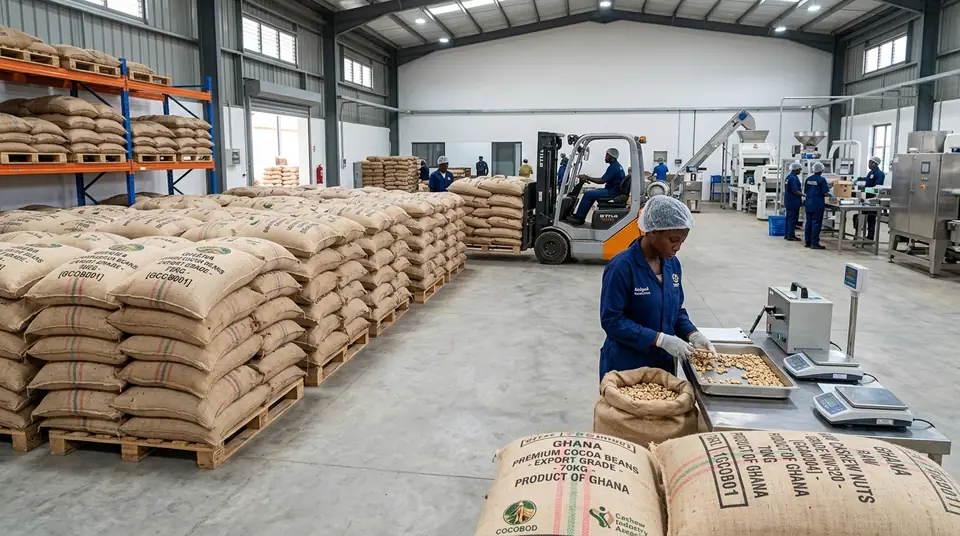
The cocoa price in Côte d'Ivoire is a guaranteed producer price, set each season by the State and the Conseil du Café-Cacao. This guide explains the mechanism, traces farm-gate prices for recent seasons with their sources and places Ivorian production in the world.
Key points
- For the 2026-2027 main crop, the farm-gate cocoa price was set at 1,200 FCFA per kilo, announced on 1 September 2026 by the Minister of Agriculture.
- The 2025-2026 main crop had opened on 1 October 2025 at 2,800 FCFA per kilo, followed by a mid-crop at 1,200 FCFA announced on 4 March 2026.
- The 2012 reform guarantees producers a minimum price of 60% of the CIF price and organises forward sales averaged over the crop.
- According to ICCO (February 2025), Côte d'Ivoire produced 2,241 thousand tonnes of beans in 2022/23 out of a world total of 5,043 thousand tonnes.
Who sets the cocoa price in Côte d'Ivoire
The producer purchase price for cocoa is not free. It is set at the start of each season by the Conseil du Café-Cacao, after government approval. The Council, whose full name is Conseil de Régulation, de Stabilisation et de Développement de la filière Café-Cacao (Council for the Regulation, Stabilisation and Development of the Coffee-Cocoa Sector), was created by Ordinance No. 2011-481 of 28 December 2011.
This is a guaranteed "farm-gate" price, paid to the producer for well-fermented, dried and sorted cocoa. The 2024-2025 main crop announcement stated that no deduction was allowed on this price, whatever the bean count, and that the Council was stepping up checks on compliance with the guaranteed price.
The year is split into two seasons: a main crop opening on 1 October and a mid-crop opening in spring. Each has its own price.
The forward sales system and the CIF price
The mechanism dates from the sector reform presented by Côte d'Ivoire to ICCO in March 2012. It guarantees coffee and cocoa producers a minimum price equal to 60% of the CIF price, that is the price delivered to the destination port including cost, insurance and freight.
On the export side, the reform set up a system of forward sales averaged over the crop (PVAM). The Council sells part of the coming crop in advance through an electronic platform, with a ceiling price above which any bid is rejected; the rest is sold during the season. Forward sales were launched on 31 January 2012.
The average price achieved in these sales is the basis for the guaranteed price of the following season. When world prices rise, the farm-gate price follows with a lag; when they fall, the government must choose between strict application of the rule and protecting farmers' income.
The cocoa price in Côte d'Ivoire, season by season
2024-2025 main crop: opened on 1 October 2024, guaranteed price of 1,800 FCFA per kilo farm-gate, according to the Conseil du Café-Cacao announcement of 15 October 2024. The price at the entrance of conditioning plants was set at 1,900 FCFA per kilo, excluding transport.
2024-2025 mid-crop: 2,200 FCFA per kilo, announced on 2 April 2025 by the Minister of State and Minister of Agriculture, Kobenan Kouassi Adjoumani, an increase of 22.2% over the main crop, according to AIP. 2025-2026 main crop: 2,800 FCFA per kilo for cocoa and 1,700 FCFA for coffee, announced on 1 October 2025 by President Alassane Ouattara, according to Fraternité Matin.
2025-2026 mid-crop: 1,200 FCFA per kilo, announced on 4 March 2026 by Minister of Agriculture Bruno Nabagné Koné. According to the report published by AllAfrica, world prices had collapsed since December 2025, and strict application of the mechanism would have given 947 FCFA per kilo; more than 1.5 million tonnes had been paid to producers at 2,800 FCFA since the start of the main crop.
2026-2027 main crop: 1,200 FCFA per kilo for cocoa and 1,300 FCFA for coffee, announced on 1 September 2026 by Bruno Nabagné Koné at the opening of the 10th Journées nationales du cacao et du chocolat (National Cocoa and Chocolate Days), according to Fraternité Matin. To the question "how much does a kilo of cocoa cost in Côte d'Ivoire", the official answer for this season is therefore 1,200 FCFA farm-gate.
Cocoa production in Côte d'Ivoire
Côte d'Ivoire is the world's largest producer. The ICCO quarterly bulletin published on 28 February 2025 gives the country 2,241 thousand tonnes of beans in 2022/23, an estimate of 1,674 thousand tonnes in 2023/24 and a forecast of 1,850 thousand tonnes in 2024/25.
For the same years, world production stood at 5,043, 4,489 and 4,840 thousand tonnes according to this bulletin. Forecasts are revised in later editions: for a contract, rely on the latest published bulletin.
According to Fraternité Matin (September 2026), the sector has more than 1.2 million cocoa farmers. For the 2026-2027 season, the producer card becomes mandatory for marketing, with the entry into force of the national traceability system.
Coffee and cocoa exports from Côte d'Ivoire: how it works
Exports go through licensed operators. Under the 2012 reform, the Conseil du Café-Cacao grants export rights to both national and international operators, and local processing plants buy through the same sales system as other operators.
The same reform kept the sector's taxes and levies at 22% of the CIF price. The 2024-2025 announcement reported a cocoa contract execution rate of 91.97% at 30 September 2024, against 95.86% for the 2022-2023 season.
For a foreign buyer, this means Ivorian cocoa is in practice bought from an exporter or processor holding contracts, not directly from the farmer. Our guide to sourcing cocoa and cashew in Côte d'Ivoire (/blog/how-to-source-cocoa-cashew-ivory-coast/) details the steps.
Cocoa varieties in Côte d'Ivoire: the "Mercedes" case
Among cocoa varieties in Côte d'Ivoire, the most often cited is the so-called "Mercedes" cocoa, developed by the Centre national de recherche agronomique (CNRA, National Centre for Agronomic Research). According to an article published in April 2019 on Abidjan.net, it is a high-yield variety resistant to drought and disease.
The same article states that the first pods appear about 18 months after planting, against three years for conventional plants, and that optimal production is reached at around three years, against six. For a buyer, the variety matters less than the quality of the lot: fermentation, drying, sorting and bean count.
Buying Ivorian cocoa: finding partners
Before committing a volume, check the exporter's licence and the quality and origin documents. The SocoAfrica directory lists Ivorian agriculture and food companies, and you can post a request for quotation for free (/rfq/) to receive proposals from listed suppliers.
For a first partner, a company verification (/verification/), available on quotation, lets you check legal existence and declared information before signing.
Frequently asked questions
- Who sets the cocoa price in Côte d'Ivoire?
- The Conseil du Café-Cacao sets the guaranteed farm-gate price at the start of each season, after government approval, and it is announced by the Minister of Agriculture or the President of the Republic.
- How much does a kilo of cocoa cost in Côte d'Ivoire?
- For the 2026-2027 main crop, the farm-gate price is 1,200 FCFA per kilo, announced on 1 September 2026. It was 2,800 FCFA in the 2025-2026 main crop.
- How much cocoa does Côte d'Ivoire produce?
- According to ICCO (February 2025), output was 2,241 thousand tonnes in 2022/23, estimated at 1,674 thousand tonnes in 2023/24, with a forecast of 1,850 thousand tonnes for 2024/25.
- How do cocoa forward sales work?
- The Conseil du Café-Cacao sells part of the crop in advance to exporters through electronic auctions; the average achieved is the basis for the guaranteed price, which must be at least 60% of the CIF price under the 2012 reform.
This guide summarises official texts as of the date shown. Rules change: check them with the body cited before any transaction.
Sources
- Coffee-Cocoa Council (gouv.ci) — Main cocoa marketing season 2024-2025 (2024)
- ICCO — Reform of Côte d’Ivoire’s coffee-cocoa sector (2012)
- AIP — Farm-gate cocoa price rises from 1800 to 2200 FCFA/kg for the 2024-2025 intermediate season (2025)
- Fraternité Matin — Farm-gate coffee and cocoa prices 2025-2026 (2025)
- AllAfrica — 2025-2026 cocoa intermediate season: guaranteed price set at 1,200 FCFA/kg (2026)
- Fraternité Matin — Farm-gate price of coffee and cocoa 2026-2027 (2026)
- ICCO — Quarterly Bulletin of Cocoa Statistics, Vol. LI No. 1, production of cocoa beans (2025)
- Abidjan.net — Cocoa farming: Mercedes, a pride of Ivorian research (2019)
Looking for a supplier?
Post a request for quotation: our team forwards it to listed suppliers in the relevant sector.