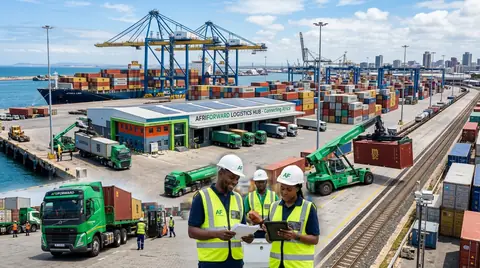
Teranga Port & Inland Logistics
Logistics, Freight & Shipping
Container handling, bonded warehousing and inland corridors from Dakar
Legal compliance, corporate tax advisory, AfCFTA trade consulting, supply chain audits and B2B translation.
Pilot phase: the listings shown are demonstrations, labelled as such.
No company is listed in the Professional Services sector yet. The Standard listing is free, and the Verified level is offered to the first companies to register.
Looking for a supplier? Our team forwards your request to companies in the network.
These companies have another main sector, so they are not counted here.

Logistics, Freight & Shipping
Container handling, bonded warehousing and inland corridors from Dakar

B2B Tech & Telecom Services
Business connectivity, bulk messaging and payment collection services in East Africa

B2B Tech & Telecom Services
Wholesale capacity, data-centre hosting and connectivity for carriers and enterprises

Logistics, Freight & Shipping
Port logistics, cold chain and freight forwarding in West Africa
Professional Services sector: no listing has this as its main sector yet in the SocoAfrica directory.
Practical guides related to the sector, each with its official sources:
ICE Morocco: understanding and checking the Common Company Identifier: The ICE is the 15-digit number that identifies a Moroccan company and its establishments with every public authority. Here is how it is assigned, what it contains and how a buyer can check a supplier's ICE before signing.
Morocco's trade register (RC): what it contains and how to consult it: The Moroccan trade register combines local registers kept by the courts and a central register kept by OMPIC. Here is what an RC reveals about a company, how to consult it online and which documents to request to check a partner.
OMPIC negative certificate: what it is for, how to get it, how long it lasts: The negative certificate confirms that a trade name is available before a company is registered in Morocco. Here is its role, the online application to OMPIC, its validity period and what it tells a buyer checking a company.
A buyer can post a free request for quotation for this sector: our team reviews it, then forwards it to listed suppliers. A company in the sector can list for free and apply for the Verified badge, awarded after a check of its documents.
The ICE is the 15-digit number that identifies a Moroccan company and its establishments with every public authority. Here is how it is assigned, what it contains and how a buyer can check a supplier's ICE before signing.
The Moroccan trade register combines local registers kept by the courts and a central register kept by OMPIC. Here is what an RC reveals about a company, how to consult it online and which documents to request to check a partner.
The negative certificate confirms that a trade name is available before a company is registered in Morocco. Here is its role, the online application to OMPIC, its validity period and what it tells a buyer checking a company.
The tax identifier is the number the Moroccan tax administration assigns to each taxpayer. Here is what it is for, how it differs from the ICE and the trade register, and how a buyer can find and check it.
A public contract in Morocco is found on the public procurement portal, run by the Trésorerie générale du Royaume, and won with a bid that complies with Decree No. 2-22-431 of 8 March 2023. This guide explains where to search, who may bid and which documents to prepare.
The 2023 public procurement decree, No. 2-22-431 of 8 March 2023, replaced the 2013 decree and applies to the State, local authorities and public institutions. Here are its official references, its start date and the provisions that matter to a company.
The CCAG-T sets the performance conditions for public works contracts in Morocco, and the CCAG-EMO does the same for engineering studies and project management contracts. Here are their reference texts, their scope and the rules that weigh most on a company's cash flow.
A provisional bond for a public contract in Morocco may not exceed two percent of the contracting authority's estimate, and purchase orders are capped at 500,000 dirhams per year and per type of service. Here are the rules on guarantees, purchase orders, subcontracting and detailed price breakdowns.
The RCCM, or Trade and Personal Property Credit Register, is the register shared by OHADA member states where traders and companies are registered. This guide explains what it contains, how to decode an RCCM number and how to check a company in Senegal, Côte d'Ivoire and Cameroon.
OHADA harmonises the business law of 17 African states through common Uniform Acts. Here is what you need to know about the treaty, the list of member states, commercial company law and the Common Court of Justice and Arbitration in Abidjan.
A tender in Morocco can come from a public buyer, bound by strict publicity rules, or from a private company free to consult whoever it wants. This guide explains where to look for each type of tender, how to put a bid together and how to publish your own request for free.
An OHADA lawyer helps you with a contract, a company, debt recovery or arbitration in the 17 OHADA member countries. This guide explains what this body of law covers, how to use the official bar directories and which questions to ask before signing an engagement letter.
In Kenya, a company's existence is checked with the Business Registration Service (BRS) through an official search on eCitizen, formerly called a CR12, and its tax number with the KRA PIN Checker. This guide explains how both checks work, what the Companies Act 2015 requires and which documents to ask a Kenyan supplier for before you sign.
The Corporate Affairs Commission (CAC) keeps Nigeria's public register of companies and business names, and anyone can search it online. This guide shows how to look up a company by name or RC number, how to read the result and which documents to ask a supplier for before you sign.
CEPICI runs the one-stop shop where Ivorian companies are set up: a single file produces the trade register entry, the tax registration with its taxpayer account number and the CNPS employer registration. Here are the documents required for an SARL, the official fees and how a buyer can check these numbers with an Ivorian supplier.
The CIPC register lets you find a South African company by its name, its registration number or a director's ID, and see its status. Here is how to run the search, read the number, and complete the check with the supplier's B-BBEE document and SARS tax compliance status.
In Senegal, public procurement is governed by Decree No. 2022-2295 of 28 December 2022 and regulated by ARCOP, which succeeded ARMP. Here is where tenders are published, who may bid, which documents to provide and how to challenge an award.
The NINEA is the single number that ANSD assigns to every business or association operating in Senegal, alongside its registration in the trade and personal property credit register (RCCM). Here is how both numbers are obtained, including through APIX, and how a buyer checks them with official tools.
The NIU is the number Cameroon's Directorate General of Taxation assigns to every taxpayer once its online tax registration is complete. Here is what it is used for, how it relates to the RCCM and the CFCE, and how a buyer can check a supplier's NIU before signing.
Ghana's Office of the Registrar of Companies (ORC) registers businesses and keeps corporate records, while the Ghana Revenue Authority (GRA) issues tax identification numbers. This guide explains which searches and documents let a buyer confirm that a Ghanaian supplier exists and is in good standing.
Post a request for quotation: our team forwards it to listed suppliers.