Morocco's 2023 public procurement decree: what Decree No. 2-22-431 changes
SocoAfrica editorial team · Updated on
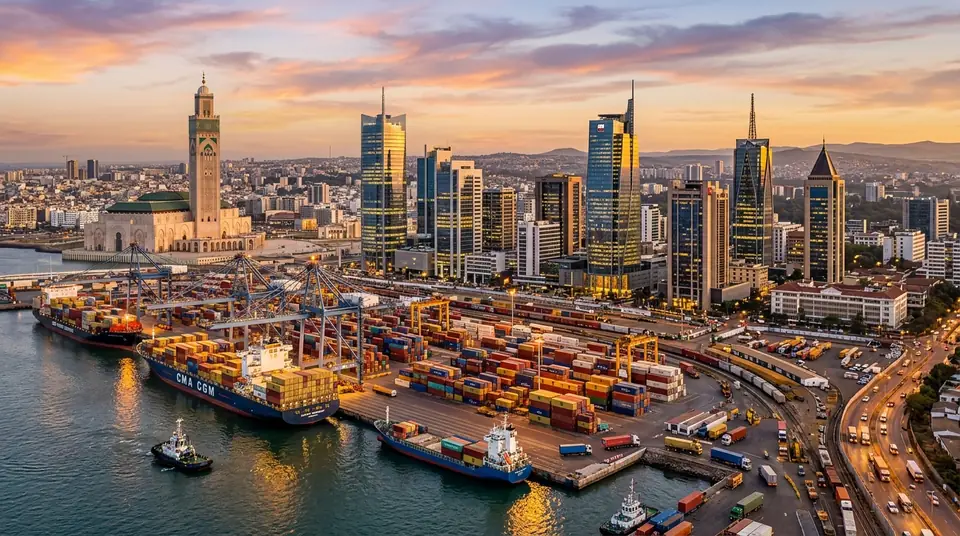
The 2023 public procurement decree, No. 2-22-431 of 8 March 2023, replaced the 2013 decree and applies to the State, local authorities and public institutions. Here are its official references, its start date and the provisions that matter to a company.
Key points
- The Arabic text of Decree No. 2-22-431 was published in Bulletin officiel No. 7176 of 9 March 2023, and its French translation in Bulletin officiel No. 7184 of 6 April 2023.
- The decree enters into force on the first day of the sixth month after its publication and repeals Decree No. 2-12-349 of 20 March 2013 (Article 169).
- Contracting authorities must reserve thirty percent of the forecast value of their annual contracts for very small, small and medium-sized enterprises established in Morocco, cooperatives and self-employed entrepreneurs (Article 148).
- A national preference of fifteen percent applies to the financial offers of bidders not established in Morocco (Article 147).
The 2023 public procurement decree: official references
The text is titled Decree No. 2-22-431 of 15 Chaabane 1444 (8 March 2023) on public procurement. It was adopted after the opinion of the national public procurement commission and after deliberation by the Government Council on 29 December 2022, as its preamble states.
The Arabic text was published in the general edition of Bulletin officiel No. 7176 of 9 March 2023. The official French translation appears in Bulletin officiel No. 7184 of 6 April 2023, official translation edition. The decree is countersigned by the minister delegate in charge of the budget.
The decree has 170 articles organised in twelve chapters, covering among other things contract types and prices, award procedures, architectural services, digitalisation, contract approval, governance, complaints and appeals, and transitional and final provisions. Several annexes complete it, including the list of services that may be bought under ordinary commercial contracts.
Entry into force and transitional provisions
Under Article 169, the decree enters into force on the first day of the sixth month following its publication in the Bulletin officiel. As publication took place on 9 March 2023, it has applied since 1 September 2023. On the same date it repeals Decree No. 2-12-349 of 20 March 2013 on public procurement, as amended and supplemented.
Article 170 provides that procedures launched before that date remain subject to the former decree. Texts adopted to implement the 2013 decree remain in force on a transitional basis until they are repealed or replaced. This applies in particular to the general administrative clauses (CCAG), which remain the reference until a new text replaces them.
A single scope and broader principles
Article 2 covers works, supply and service contracts awarded on behalf of the State, local authorities and public institutions or other public-law entities required to apply these rules. A company bidding for a municipality, a ministry or a public institution therefore meets the same rules.
Article 1 restates the principles of free access, equal treatment, protection of bidders' rights and transparency, plus integrity and good governance. It asks contracting authorities to take into account, as appropriate, economic, social and environmental aspects, sustainable development, energy efficiency and the promotion of innovation.
National preference and measures for small businesses
Article 147 organises the national preference. When bidders not established in Morocco take part, the amount of their financial offer is reduced or increased by fifteen percent depending on its position relative to the reference price, subject to international agreements ratified by Morocco. For studies, the fifteen percent increase applies directly. A consortium is exempt when its members established in Morocco hold at least thirty percent of it.
Article 148 requires contracting authorities to reserve thirty percent of the forecast value of the contracts they plan to launch each budget year for very small, small and medium-sized enterprises established in Morocco, including young innovative companies, cooperatives, cooperative unions and self-employed entrepreneurs. They must also publish each year on the portal the number and total value of contracts awarded to these businesses.
On subcontracting, Article 151 caps the subcontracted share at half of the contract value including tax and requires a contractor who subcontracts to use providers established in Morocco, in particular small businesses, cooperatives and self-employed entrepreneurs.
Procedures and digital tools provided by the decree
Besides open, restricted and prequalified calls for tenders, Article 19 provides for a simplified open call for tenders for contracts with an estimated value of one million dirhams or less excluding tax. The decree also has articles on design-and-build contracts (Article 11), competitive dialogue (Article 12) and unsolicited offers (Article 13).
The digitalisation chapter provides for electronic submission and withdrawal of bids on the public procurement portal (Article 135), an electronic database of contractors managed by the Trésorerie générale du Royaume (Article 137), electronic auctions (Article 138) and purchasing from electronic catalogues (Article 139).
Where to find the 2023 public procurement decree in PDF
The marchespublics.gov.ma portal offers a French version of the decree in PDF format in its regulations section. Article 134 of the decree itself provides that the laws and regulations governing public procurement are published there.
The authoritative text is the one in the Bulletin officiel. For a precise citation in a bid, a complaint or a contract, refer to the article number and to Bulletin officiel No. 7176 (Arabic text) or No. 7184 (French translation).
Public contracts, private tenders and partners
The decree governs public procurement. Purchases by private companies follow their own rules. SocoAfrica hosts private calls for tenders free of charge on its /rfq/ page, which is separate from the public procurement portal.
The subcontracting rules and the share reserved for small businesses push large contractors to work with companies established in Morocco. SocoAfrica's Morocco business directory and its /verification/ page help identify such partners and check that they exist before signing.
Frequently asked questions
- Which public procurement decree is in force in Morocco?
- It is Decree No. 2-22-431 of 8 March 2023 on public procurement, which repealed Decree No. 2-12-349 of 20 March 2013 (Article 169).
- Since when has the 2023 public procurement decree applied?
- Article 169 sets entry into force on the first day of the sixth month after publication in the Bulletin officiel of 9 March 2023, that is 1 September 2023. Procedures launched before that date remain governed by the former decree (Article 170).
- Where can I download the 2023 public procurement decree in PDF?
- A French PDF version is available on the marchespublics.gov.ma portal. The authoritative version is published in Bulletin officiel No. 7176, with its French translation in Bulletin officiel No. 7184.
- Does the decree reserve a share of contracts for SMEs?
- Yes. Article 148 requires contracting authorities to reserve thirty percent of the forecast value of their annual contracts for small businesses established in Morocco, cooperatives, their unions and self-employed entrepreneurs.
This guide summarises official texts as of the date shown. Rules change: check them with the body cited before any transaction.
Sources
- Official Gazette No. 7184 (official translation edition) — Decree No. 2-22-431 of 8 March 2023 on public procurement (in French) (2023)
- Public Procurement Portal — Public procurement decree, French version (PDF) (2023)
- Morocco Public Procurement Portal — Home page and sections (2026)
Looking for a supplier?
Post a request for quotation: our team forwards it to listed suppliers in the relevant sector.