Culinary or cosmetic argan oil: production, standards and cooperatives in Morocco
SocoAfrica editorial team · Updated on
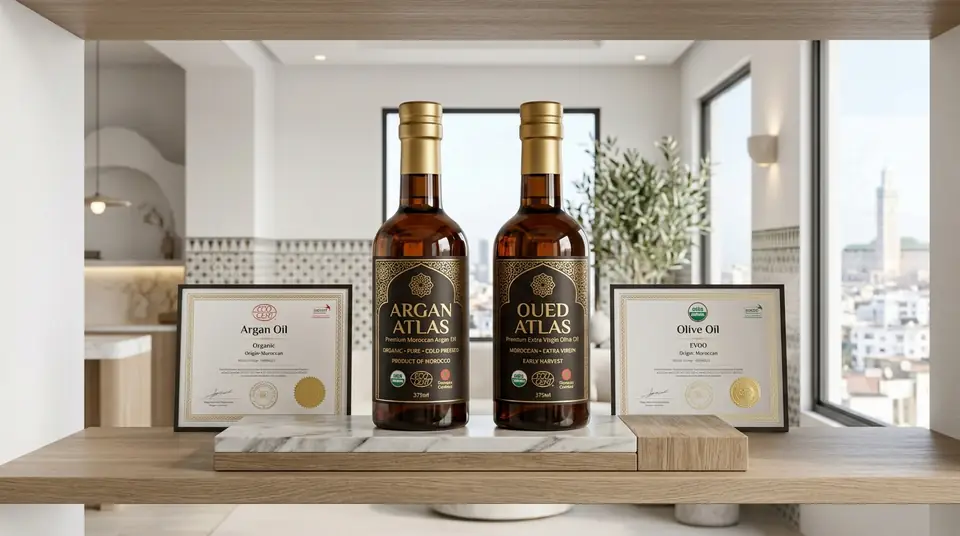
Culinary and cosmetic argan oil come from the same Moroccan fruit, but not from the same kernels: one is roasted, the other is not. This guide explains production, uses, the Moroccan standard, the Argane PGI, the argan forest and organic argan oil for professional buyers.
Key points
- According to Gharby and Charrouf (2022), culinary argan oil is obtained by cold-pressing kernels roasted for a few minutes, while cosmetic oil comes from unroasted kernels.
- The Moroccan standard NM 08.5.090 grades argan oil by acidity, peroxide value and specific extinction; the extra virgin grade requires acidity below 0.8 g per 100 g (Gharby and Charrouf, 2022).
- UNESCO gives 1998 as the year of nomination of the Arganeraie Biosphere Reserve, which covers 2,499,970 hectares in south-western Morocco.
- The Argane PGI is managed by AMIGHA, which in 2015 brought together economic interest groups, cooperative unions, producing companies and argan manufacturers.
Two argan oils from the same fruit
The argan tree (Argania spinosa) is endemic to south-western Morocco, UNESCO notes, adding that its oil is used in cooking, medicine and cosmetics. Moroccan argan oil is therefore sold in two main forms that a buyer must tell apart from the first price request. On export markets it is sold as “argan oil” (argan oil Morocco).
The difference lies not in the fruit but in how the kernels are prepared. Gharby and Charrouf (2022) explain that, depending on kernel preparation, the result is either food-grade or cosmetic-grade oil.
FAO (2021) sums up the two outlets: culinary oil is used in cooking, much like olive oil, while cosmetic oil nourishes skin and hair. Edible argan oil and skin-care oil are therefore not interchangeable in a purchase contract.
Making culinary argan oil: roasting
Culinary argan oil is made by cold-pressing kernels roasted for a few minutes (Gharby and Charrouf, 2022). The same authors state that traditional roasting on clay plates takes 30 to 40 minutes on average per kilogram of kernels.
The traditional process is manual: according to WIPO (2010), nuts are cracked by hand between two stones, and kernels intended for cooking are roasted before being ground in a hand mill called an azerg. Gharby and Charrouf (2022) estimate that one person needs 24 hours of work to extract about 1 litre of oil from 50 kg of fruit.
Mechanical extraction keeps the same basic steps but replaces manual peeling and pressing with machines; water is no longer used, and both industrial units and cooperatives have adopted hydraulic presses (Gharby and Charrouf, 2022).
Culinary argan oil is eaten with bread, drizzled over salads, fish or couscous, and used in amlou, a paste made of roasted almonds, honey and argan oil (Gharby and Charrouf, 2022).
Cosmetic argan oil: unroasted kernels
Cosmetic argan oil is prepared from unroasted kernels (Gharby and Charrouf, 2022). It is used as a moisturiser and added to shampoos, which makes it a sought-after raw material for skin-care manufacturers.
In terms of composition, the same study puts oleic acid at 43 to 49 g per 100 g and linoleic acid at 29.3 to 36 g per 100 g, in an oil made of about 80% unsaturated fatty acids. Total tocopherols reach 60 to 90 mg per 100 g, with gamma-tocopherol as the main form.
For a buyer of argan oil for cosmetics, the practical point is simple: state 'cosmetic grade, unroasted kernels' on the purchase order and ask for the batch analysis report, rather than relying on a trade name.
Moroccan argan oil standards and the Argane PGI
Quality is assessed under the Moroccan standard NM 08.5.090, which uses acidity, peroxide value and specific extinction. It distinguishes extra virgin, fine virgin, ordinary virgin and lampante grades; extra virgin requires acidity below 0.8 g per 100 g and a peroxide value below 15 mEq O2 per kg (Gharby and Charrouf, 2022).
The Argane protected geographical indication is managed by the Moroccan association for the geographical indication of Argane oil (AMIGHA). According to its 2015 presentation, the PGI reserves the name for products from the geographical area that comply with the specification, and the product is recognised by the Ministry of Agriculture and certified by an approved body.
WIPO (2010) highlights the expected benefits of such an indication: protection of the name, better organisation of producers, a guarantee of origin and easier detection of counterfeits.
Export requirements (standard, organic certification for the European Union, documents) are covered in our dedicated guide: /blog/organic-argan-oil-cosmetics-export-standards/.
The argan forest: biosphere reserve and agricultural heritage
The Arganeraie Biosphere Reserve, for which UNESCO gives 1998 as the year of nomination, covers 2,499,970 terrestrial hectares between the High Atlas and the Anti-Atlas, with the Atlantic Ocean to the west. UNESCO also reports long droughts followed by heavy rain linked to climate change.
In 2018, FAO recognised the argan-based agro-sylvo-pastoral system of Ait Souab - Ait Mansour as a Globally Important Agricultural Heritage System (FAO, 2021). The United Nations has also dedicated 10 May to an international day of the argan tree.
For a buyer, these designations are a reminder that the resource is limited to a specific area: traceability of origin is part of the value of Moroccan argan oil.
Women's cooperatives and organic argan oil
According to WIPO (2010), women began setting up cooperatives in the early 1990s; the Amal cooperative in Tamanar is described as the first Moroccan cooperative run entirely by women. Gharby and Charrouf (2022) state that the oil is produced by women's cooperatives using semi-industrial mechanical extraction.
In 2015, AMIGHA's members included four economic interest groups, three cooperative unions, the national association of argan cooperatives, an association of producing companies and three manufacturers. These bodies are often the direct contacts for bulk buyers.
Organic argan oil follows a different logic from the PGI: organic certification attests a production method under the rules of the destination market, while the PGI attests an origin and a specification. An oil may carry one, the other or both; request each certificate separately, with its issuing body and expiry date.
Buying argan oil in Morocco with SocoAfrica
Before ordering, put in writing the grade (culinary or cosmetic), the target category under NM 08.5.090, the analysis report expected for each batch and, where relevant, the PGI and organic certificates.
SocoAfrica offers a company directory by country, including Morocco, and company verification (/verification/) to check that a cooperative or exporter exists. You can also post a request for quotation free of charge (/rfq/), specifying volumes, packaging and the certifications you require.
Frequently asked questions
- Is cosmetic argan oil edible?
- It is not prepared for food use: culinary oil comes from roasted kernels, cosmetic oil from unroasted kernels intended for skin and hair (Gharby and Charrouf, 2022). For cooking, buy an argan oil expressly sold as culinary.
- How can I recognise culinary argan oil?
- It is made from roasted kernels and must be presented as culinary on the label and in the contract. Ask for the batch analysis report under NM 08.5.090 (acidity, peroxide value, specific extinction).
- What is the Argane PGI?
- It is the protected geographical indication for argan oil, managed by AMIGHA. It reserves the name for oils from the defined area that comply with a specification and are certified by an approved body.
- Is organic argan oil always PGI?
- No. Organic certification covers the production method, the PGI covers origin and the specification; they are two separate certificates to check individually.
This guide summarises official texts as of the date shown. Rules change: check them with the body cited before any transaction.
Sources
- Gharby S., Charrouf Z. — Argan Oil: Chemical Composition, Extraction Process, and Quality Control (Frontiers in Nutrition) (2022)
- UNESCO — Arganeraie Biosphere Reserve, Morocco (s.d.)
- WIPO — Protecting society and the environment with a geographical indication (2010)
- FAO — The Moroccan landscape, traditions and communities behind argan and its oil (2021)
- AMIGHA (oriGIn, Geneva) — Geographical indications and sustainable development: the case of the Argan PGI (2015)
Looking for a supplier?
Post a request for quotation: our team forwards it to listed suppliers in the relevant sector.