Exporting from Morocco: export procedure, documents, licences and certificates
SocoAfrica editorial team · Updated on
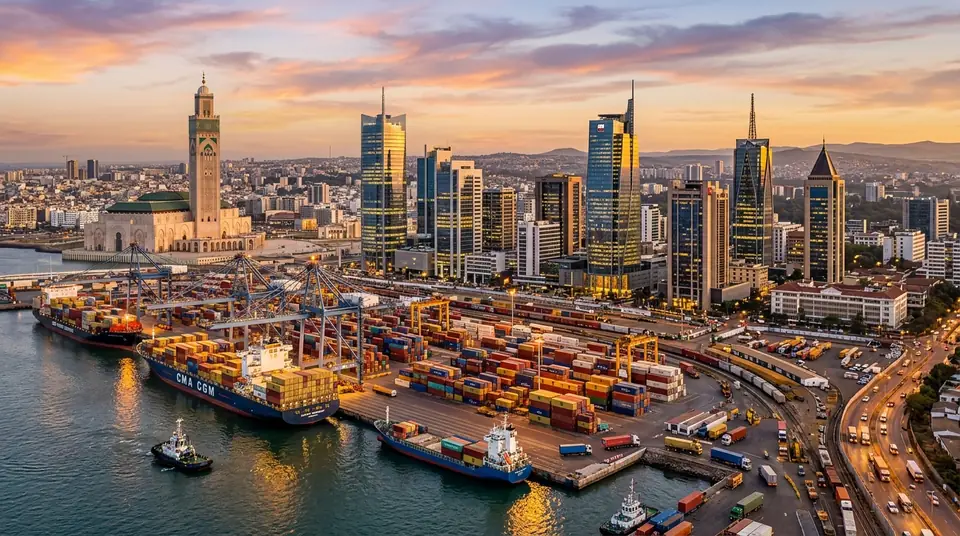
Exporting from Morocco rests on a principle of freedom, with exceptions: licences, health controls and rules of origin. This guide covers Morocco's export procedure, documents, ONSSA, industrial acceleration zones, export insurance and exported products.
Key points
- All products may be exported freely, except those listed in Annex II of Order No. 1308-94 of 19 April 1994, which require a licence (Foreign Trade Department).
- An export licence is valid for three months from the visa of the Department in charge of Foreign Trade, which must notify its decision within 30 days.
- ONSSA requires food establishments to hold a health approval or authorisation, under Law No. 28-07 on the safety of food products.
- According to the Office des changes (2024), the automotive industry remains the leading export sector with MAD 157.6 billion, ahead of phosphates and derivatives and agriculture and agri-food.
Exports from Morocco: the principle of freedom and preliminary formalities
According to the 'Export procedures' guide of the Foreign Trade Department, exporting requires registration in the commercial register, with the court of the place of the main establishment or head office; the register number must appear on export documents.
The same guide sets out the principle: all products may be exported freely, except those listed in Annex II of Order No. 1308-94 of 19 April 1994, as amended and supplemented, which require a licence.
For freely exportable goods, the exporter draws up an exchange undertaking, presented to the customs office with a pro forma invoice showing the total value, unit price (ex works, FOB, FAS or FCA), quantity, trade description and payment terms.
Handicraft products follow an additional rule: registration in the file of handicraft exporters, with the ministry in charge of Handicrafts, is required for any export operation.
Export licences in Morocco: which cases apply
For Annex II products, the export licence is drawn up in six copies with two copies of a pro forma invoice. It is filed against receipt with the Department in charge of Foreign Trade, which forwards it to the relevant ministry for an opinion (Foreign Trade Department guide).
The decision to grant or refuse is notified within no more than 30 days of filing, and any refusal must state its reasons. The licence is valid for three months from the date of the visa.
The 'First export' sheet on the eRegulations Rabat portal states that the application is made online through the PortNet portal, on the basis of Law No. 13-89 on foreign trade, and that the list of products concerned is published on the customs website. Check the status of your tariff code before signing a contract.
Export documents in Morocco: clearance, BADR and origin
For a simple export, the file includes the Single Goods Declaration (DUM), the commercial invoice, the packing list, the export document, the transport document, the certificate of origin and, depending on the product, the inspection certificate (Foreign Trade Department guide).
The DUM is filed electronically in BADR, the customs network database and online goods clearance system; the exporter or its declarant must first obtain an access code (handicraft exporter's guide). After clearance, the customs entry is recorded on the export document and a copy goes to the Office des changes.
Tariff preferences require proof of origin: an EUR.1 movement certificate or EUR-MED certificate for the European Union, a certificate of origin for free trade agreements, and a 'Form A' under the Generalised System of Preferences, according to the ministry guide.
Finally, the guide recalls the obligation to repatriate export proceeds and cites a 150-day period after shipment, based on a 1993 Office des changes circular. Ask your bank to confirm the rule in force at the time of the transaction.
Health certificates for exports from Morocco: ONSSA and technical control
For agri-food exports, Morocco first imposes an establishment requirement: according to ONSSA, food and feed businesses must hold a health approval or authorisation under Law No. 28-07, Decree No. 2-10-473 and Order No. 244-13. The application is filed with the ONSSA inspection service of the province where the establishment is located.
For plant products, the exporter files a health certification file: application, product sheet, packing list, invoice, batch analysis reports from ONSSA or ONSSA-approved laboratories, label samples, a copy of the health approval or authorisation, and the requirements of the destination country (ONSSA).
ONSSA then carries out systematic documentary, identity and physical checks, as well as analytical checks through sampling. The importing country's requirements are part of the reference framework.
On top of this comes the technical quality control entrusted to EACCE for fresh or processed fruit and vegetables, fishery products, wines, cereals, pulses, dried fruit and herbal products, with registration in the EACCE register renewable every year (Foreign Trade Department guide).
Export free zones, ZAIs and export insurance in Morocco
People still often speak of export free zones; recent texts use the term industrial acceleration zones (ZAI). In January 2024, the House of Representatives adopted bill No. 56-23, which makes the advantages granted in these zones exclusive, with no combination with other advantages under investment promotion legislation (Bourse News, 2024).
The network is growing: on 9 October 2025, the government adopted two draft decrees creating the Fès-Bensouda and Skhirat ZAIs, open in particular to automotive, aeronautics, textiles, renewable energy equipment or plastics depending on the zone (maroc.ma, 2025).
To cover the risk of non-payment, the Moroccan export insurance company SMAEX offers tailored, simplified or medium-term credit insurance, prospecting insurance, trade fair insurance and debt collection assistance. Terms and premiums are set with SMAEX for each contract.
What does Morocco export? Morocco's main export products
According to the Office des changes 2024 report quoted by the maroc.ma portal, the automotive industry remained the leading export sector for the second year running, at MAD 157.6 billion, up 6.3%.
It is followed by phosphates and derivatives at MAD 87.1 billion (up 13.5%), then agriculture and agri-food at MAD 87 billion. Aeronautics grew by 14.9%, while textiles and leather reached MAD 45.9 billion, down slightly by 0.5% (maroc.ma, 2025).
Morocco's exports are therefore dominated by industry, but agri-food weighs almost as much as phosphates: it is the sector where ONSSA and destination-country requirements most often set the timetable for a shipment.
Exporting from or to Morocco with SocoAfrica
If you export from Morocco, the SocoAfrica country directory helps buyers find you, and company verification (/verification/) lets you check a partner before granting payment terms.
If you want to export to Morocco, Moroccan import rules differ from those set out here. You can find importers in the Morocco directory or post a free request for quotation (/rfq/) to receive offers from suppliers.
Frequently asked questions
- Do I need a licence to export from Morocco?
- Not as a general rule: products may be exported freely. Only those in Annex II of Order No. 1308-94, as amended, require a licence, valid for three months after the visa.
- Which documents are needed to export from Morocco?
- The DUM filed in BADR, the commercial invoice, the packing list, the export document, the transport document, the certificate of origin and, depending on the product, an inspection or health certificate.
- Who issues export health certificates in Morocco?
- ONSSA, after documentary, identity, physical and analytical checks. The establishment must already hold an ONSSA health approval or authorisation.
- What are Morocco's main export products?
- In 2024, the automotive industry came first with MAD 157.6 billion, ahead of phosphates and derivatives (87.1 billion) and agriculture and agri-food (87 billion), according to the Office des changes.
This guide summarises official texts as of the date shown. Rules change: check them with the body cited before any transaction.
Sources
- Ministry of Industry and Trade, Department of Foreign Trade — Export procedures (in French) (s.d.)
- eRegulations Rabat — First export: obtaining an export licence (s.d.)
- Ministry of Tourism, Handicrafts and Social Economy — Handicraft exporter’s guide (in French) (2022)
- ONSSA — Export of plant products: inspection procedure (s.d.)
- ONSSA — Approval and authorisation of agri-food establishments (s.d.)
- Maroc.ma — Automotive keeps its position as the leading export sector in 2024 (in French) (2025)
- Maroc.ma — The government adopts two draft decrees creating two industrial acceleration zones (2025)
- Bourse News — The House of Representatives adopts a bill on industrial acceleration zones (2024)
Looking for a supplier?
Post a request for quotation: our team forwards it to listed suppliers in the relevant sector.